






If you have a heavier bust, you already know the signs. Straps carving into your shoulders. A band that rides up the moment you lift your arms. Enough movement on a run that you find yourself holding an arm across your chest.
The short answer, before anything else: you want a wide underband, a wide racerback, and high front coverage. Those three things do most of the work. Strap style, colour and anything described as a feature come after.
I've spent thirteen years in my family's manufacturing business, and since 2023 we've been knitting our own activewear in Mumbai. Watching bras come off the machine and go onto real bodies teaches you quickly which parts matter and which are decoration.
The band does the supporting, not the straps
This is the thing most people have backwards.
If your straps are digging in, the instinct is to loosen them, or to buy a bra with wider straps. Both treat the symptom. Straps dig in because the band isn't holding enough of the weight, so your shoulders take what the band should be carrying.
What a good band does: sits level all the way round, stays there when you raise both arms, and feels secure without you being aware of it.
What to check: lift your arms overhead. If the band rides up at the back, it's too loose, and the answer is usually a firmer or wider band rather than tighter straps. A wider underband spreads the pressure over more of your ribcage, which is why it feels more comfortable and holds better at the same time.
One advantage of knitted construction here: our bands are knitted as part of the garment rather than being elastic stitched on. There's no hard seam sitting exactly where a band is under the most tension, which matters more the more support you need.
Coverage and back shape: the part nobody explains

Shop: Breeze Bandeau Bra
Here's what actually separates a supportive bra from a pretty one.
More coverage means more support. A high neckline holds more of the breast in place and spreads the load across a wider area. A scoop or plunge leaves more free to move. Between two bras at the same impact level, the one with the higher front will hold better, every time.
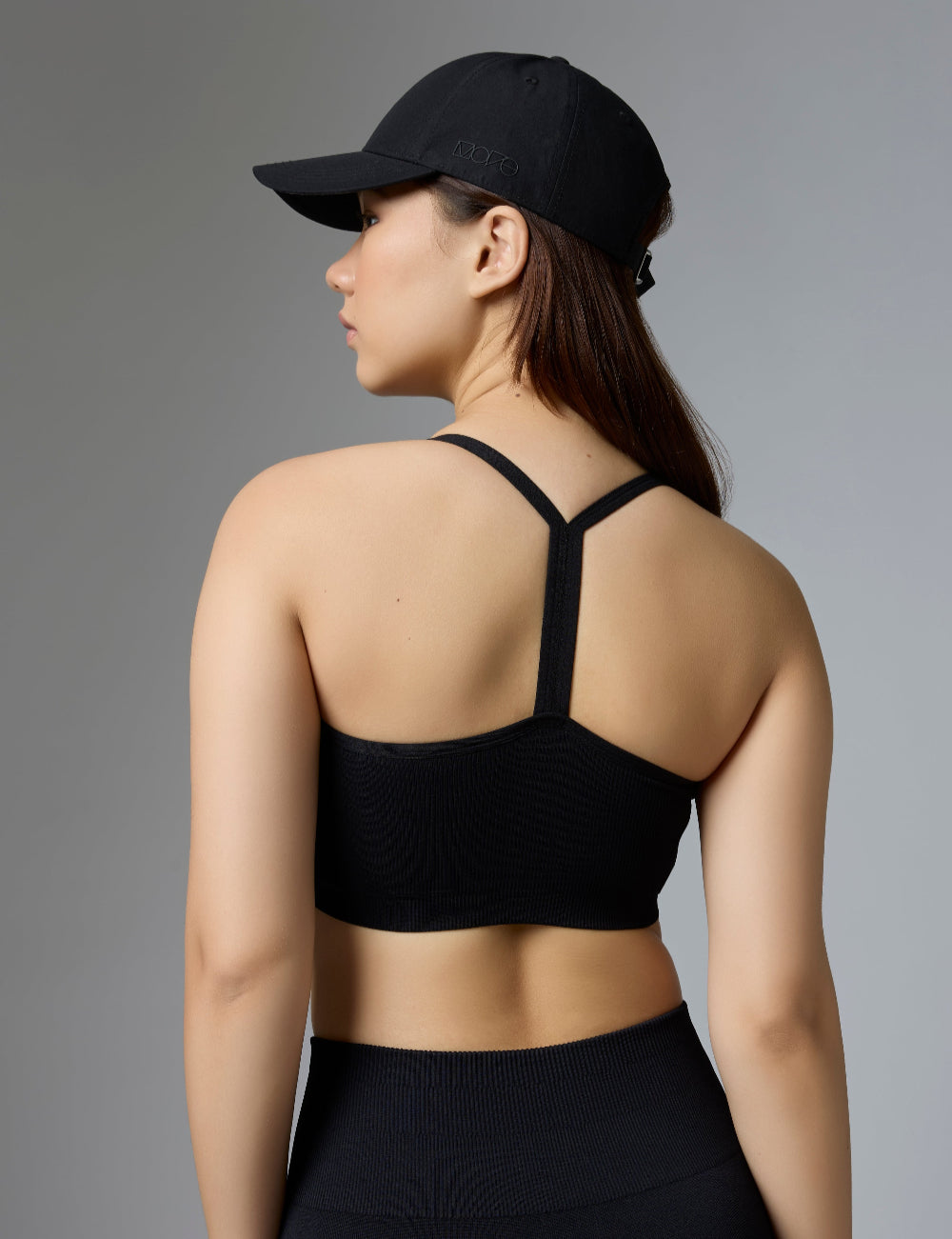
A wider racerback does more than a narrow one. It spreads the pull across your upper back instead of concentrating it into two thin lines. This is the single biggest reason racerbacks feel more supportive, and the reason narrow straps dig in faster regardless of how well padded they are.
Racerbacks also free up your shoulders. The straps sit inward, away from the joint, so nothing catches when you press overhead or reach behind you.
Longline adds stability. More fabric through the body means less movement overall, and a longline bra sits against your ribcage rather than perching on it.
If you remember one rule from this piece: match the impact level to your activity first, then use coverage and back shape to fine-tune. A low impact racerback with a high neck will out-support a low impact scoop.
What I'd actually put you in

Shop: Espresso Sports Bra | Rainforest Sports Bra
Being specific, because a guide that won't recommend anything isn't much of a guide.
Start here: the Airwave Sports Bra. It's our most popular high-impact style and the one I'd put most people with a heavier bust into. Longer, wider underband. Wide racerback. High coverage. And knitted mesh through the back with a subtler panel at the front, so it breathes rather than trapping heat, which matters when you're wearing more fabric.
If you want maximum support: the Slingshot Sports Bra. It's the most compressive and most supportive bra we make. I'll be straight with you, it's a genuine effort to get into and out of. That's the trade-off for how much it holds. If support is your priority and you don't mind a wrestle at either end of a session, it's the one.
For high impact with more length: the Camo Sports Bra. Longline, high neck, in a knitted camo design. The coverage does the support work.
For HIIT: the FlexRib Power Bra. Built on FlexRib, which is a ribbed knit with real weight to it and, more importantly, retention. It holds its shape through repeated wear and washing rather than going slack by month three. That matters more for a heavier bust than for anyone else, because a bra that's relaxed is a bra that isn't working.
For strength training and gym sessions: the Tidal Sports Bra. A classic racerback, which is the most straightforwardly supportive shape at medium impact.
Browse Feier's high impact sports bras →
Is an adjustable sports bra worth it?

Shop: Butter FlexRib Bold Bra | Onyx FlexRib Bold Bra
Yes, for a reason people don't usually mention.
Torsos, shoulders and busts don't arrive in matched proportions, so adjustable straps let you fix the gap between your shoulder measurement and your band measurement. If your straps slip or dig no matter which size you try, that gap is usually why.
The second reason is time. A knit relaxes slightly with wear, and being able to take up a few millimetres is what keeps a bra comfortable in month eight rather than month two.
From our range, the FlexRib Bold Bra has a wider underband with straps that adjust at the back, and the Breeze Bandeau Bra has adjustable straps, removable cups and knitted mesh for ventilation.
One honest note on the Breeze Bandeau: it holds beautifully through strength training and lifting, but it isn't built for running, jumping or HIIT. I'd rather tell you that here than have you find out mid-session.
And a general caution: adjustable does not mean high support. The two are unrelated. Check the impact level separately.
Does a criss cross back give better support?
Not by itself, no.
A criss cross or crossback bra has straps that cross over the back rather than meeting in a racerback or running straight down. Plenty of people prefer it, partly because it feels more secure and partly because it works under sleeveless tops.
But the back arrangement on its own tells you very little. What matters is how wide the straps are and how much of your back they cover. A wide crossback spreads the load well. A narrow one, with thin straps meeting at a single point, concentrates it, which is the opposite of what you want with a heavier bust.
Our Lift Strappy Sports Bra is a multi-strap cross back with a scoop neck, and the back is genuinely the point of it. The knit is firm enough that it holds well despite the lower coverage, which makes it a good strength-training option. I wouldn't send you running in it.
If you like convertible styles, the FlexRib Perfect Convertible Bra and Radiant Convertible Bra both switch between back arrangements. They're lovely and they're useful under different necklines, but both sit at low impact. If you're a heavier bust looking for run support, they aren't the ones.
The fit check, before you commit
Five things, two minutes, in front of a mirror.
- Raise your arms: The band should stay level, not ride up. If it rides, it's too loose.
- Check the straps: Two fingers should slide under comfortably. If they're leaving marks in thirty seconds, the band is doing too little, not the straps too much.
- Look at the front: It should sit flat against you, with no pulling or gapping at the edges.
- Move: Bend, twist, reach overhead. For anything high impact, jog on the spot for ten seconds.
- Breathe: Secure is right. Restricted is not, and tighter is not the same as more supportive.
That last point is worth sitting with. The instinct with a heavier bust is to size down for more hold, and it almost always backfires: too much compression is uncomfortable, it marks you, and it doesn't actually reduce movement as much as a correctly fitted wider band does.
What I'd leave you with
Support and comfort are not opposites, and you should not have to accept being uncomfortable as the price of being held.
Get the band right first, because the band is where the support lives. Then take as much coverage and as wide a back as you're happy wearing. Then, and only then, think about how it looks, because by that point you'll have a shortlist that actually works.
And if your week includes both a studio class and a run, two bras is the honest answer. One bra that's wrong for half your week ends up unworn.
Explore Feier's sports bras by impact level →
- Natasha Vora, Founder of Feier
FAQs
Which sports bra is best for a heavier bust?
Look for a wide underband, a wide racerback and high front coverage, in a high impact style if you run or train hard. From our range, the Airwave Sports Bra is where I'd start. The Slingshot Sports Bra holds more if you want maximum support and don't mind the effort getting into it.
Do wider straps help with a heavier bust?
They help a little, but the band matters more. Straps dig in when the band isn't carrying enough of the weight. A wider, firmer band usually solves shoulder pain better than wider straps do.
Is a criss cross bra good for a heavier bust?
It depends on how wide the straps are and how much back they cover, not on the crossing itself. A wide crossback spreads the load well. A narrow one concentrates it, which is what you're trying to avoid.
Are adjustable sports bras better for a heavier bust?
They're useful, because they let you fix the mismatch between your shoulder and band measurements, and they let you take up slack as the knit relaxes over time. But adjustable straps don't tell you anything about support level, so check that separately.
Should a sports bra feel tight?
Secure, not tight. You should breathe and move freely. Sizing down for extra hold is a common mistake with a heavier bust, and a correctly fitted wider band controls movement better than a bra that's too small.
Padded or unpadded for a heavier bust?
Padding is about shape, not support, so pick whichever you prefer. Most of our bras take removable cups so you can decide. Focus on the band, coverage and back shape instead.
Can I wear the same sports bra for the gym and for running?
Only if it's rated for the harder of the two. Running is repetitive vertical movement and it's the most demanding thing you'll ask a bra to do. A bra that's comfortable for weights can leave you under-supported on a run.
How do I know if my sports bra is supportive enough?
Jog on the spot for ten seconds. If the band rides up, the straps slip, or you're aware of movement you don't like, you need a different size or a higher impact level. You shouldn't have to hold yourself.


